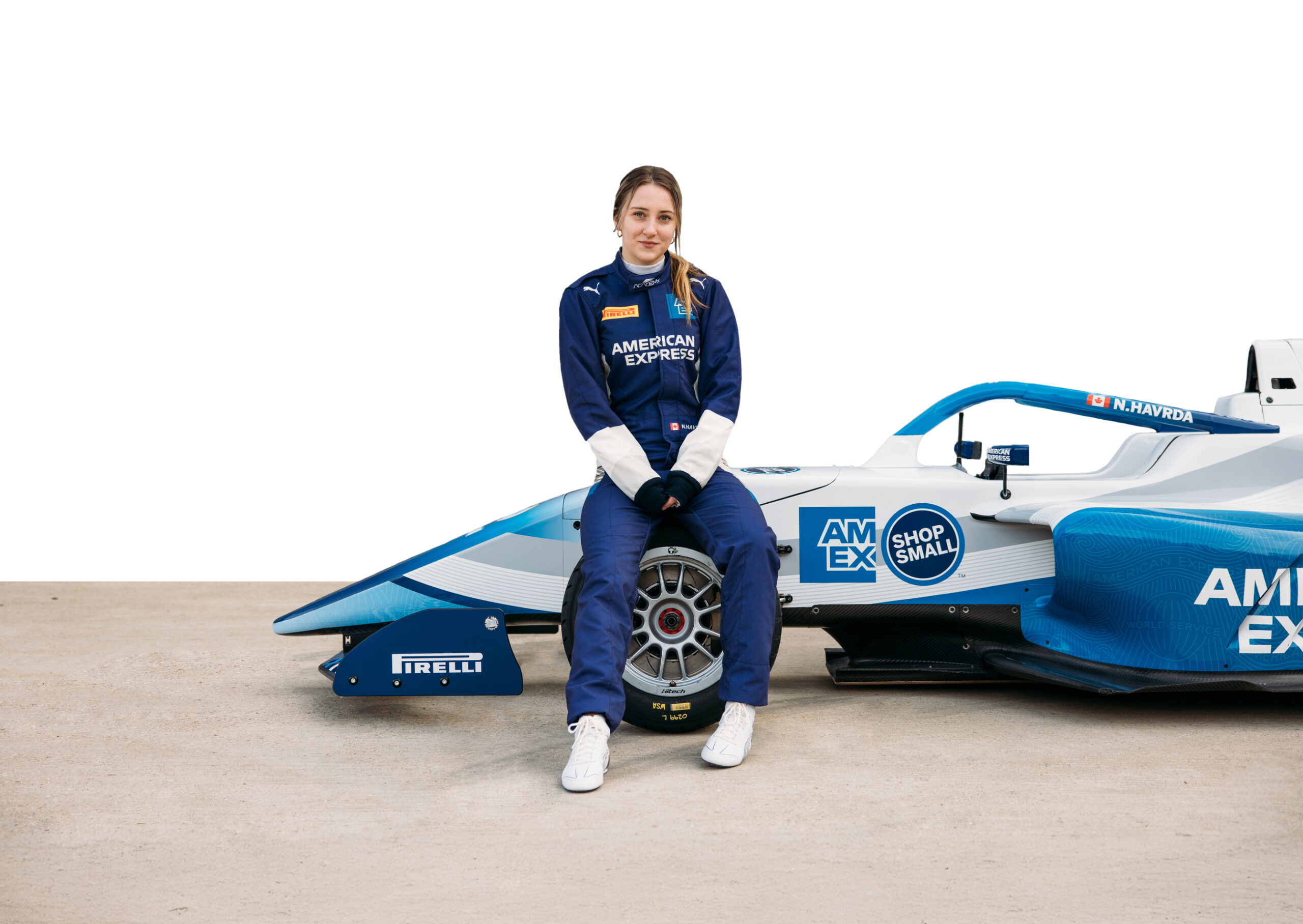
At just 19 years old, Nicole Havrda is already carving out an incredible place in international motorsport. As a Canadian competitor in the F1 Academy series, she stands among a new generation of drivers redefining what excellence looks like on the global racing stage.
Representing the Comox Valley and Vancouver Island, Nicole’s journey reflects far more than speed. It is a story of discipline, technical mastery, mental resilience, and an unrelenting commitment to growth qualities equally respected in elite sport and military service.
In this interview, Nicole reflects on the realities of competing at the highest levels of racing, the demands of performing under pressure, and the responsibility that comes with being a role model for young Canadians, particularly young women pursuing ambitious paths in high-performance and traditionally male-dominated fields.
Behind her composure on the track stands a foundation built at home. Nicole is quick to acknowledge the steady influence of her father, Martin, whose belief in her potential never wavered, and the solid encouragement of her mother and brother, who have celebrated every milestone and steadied her through setbacks.
Alongside her family, dedicated coaches have refined her technical skill and strengthened her mental approach, defining not only a competitive driver, but a confident young woman. Together, their guidance and support form the quiet engine powering her ascent—reminding her that while racing may be an individual pursuit, the success that comes with it is not alone.
Your journey into international motorsport began well before most athletes find their footing. What moments confirmed this was the path you wanted to pursue seriously?
Although many athletes begin their motorsport journey at a very young age, I actually started later than most. While many drivers enter karting as early as four or six years old, I spent my early years as a competitive swimmer for six years, which helped shape my discipline and mindset as an athlete. Motorsport was never something I was drawn to initially, and I wasn’t particularly interested in cars, and racing wasn’t on my radar. That changed during a family trip to Europe when my dad took us to watch a Formula race. The moment I heard the cars and felt the track’s energy, something shifted.
I remember getting goosebumps instantly, and in that moment, I knew this was what I wanted to pursue. Swimming had taught me how to compete, but it never gave me that visceral feeling. Racing did. Even today, watching motorsport brings back that same rush and excitement. That emotional connection, the adrenaline, and the intensity of the sport completely captured me. Shortly after that experience, I began karting on Vancouver Island, and that marked the true beginning of my journey into motorsport.
Competing in the F1 Academy places you among an elite group of drivers globally. How has this environment reshaped your understanding of performance and pressure?
Competing in the F1 Academy was one of the most intense experiences of my career. It was an extraordinary opportunity, but also one of the most demanding and painful seasons I have faced. The environment exposed me to a level of pressure I had never experienced before, not only on the track but also emotionally and mentally. It showed me how isolating racing can be and revealed the less glamorous realities of the sport. At the same time, there were moments of pride and growth that made the challenges worthwhile. Being constantly evaluated, knowing that expectations are high and that people are watching, forces you to mature quickly.
Beyond performance, the experience accelerated my growth off the track. Working closely with teams, sponsors, and business partners strengthened my communication skills and discipline. From training, simulator work, and testing to constant travel, I learned how to manage myself independently. At just 19, travelling the world and handling pressure on my own has reshaped my understanding of resilience and what it truly means to compete at the highest level.
Motorsport rewards precision and composure. How have you trained your mind to remain steady when everything happens at once?
Mental preparation has become one of the most important parts of my training. Working with my mental performance coach has completely changed how I approach racing. During the Academy season, I had some difficult races, but she helped me mentally reset before each event. Learning how to clear my mind, refocus, and move forward without carrying past mistakes has been critical. Racing is fast, intense, and unforgiving, and mental strength often makes the difference.
Representing Canada and Vancouver Island on an international stage carries weight. What does that responsibility mean to you personally?
Representing Canada, and especially Vancouver Island, on an international stage is a responsibility I carry with pride. As a Canadian racer, I’m aware that there are not many of us competing at this level, which makes wearing the Canadian flag around the world even more meaningful to me. Coming from Vancouver Island and travelling from the west coast to race internationally is not always easy, but it has made me appreciate the opportunity even more. I know I’m carrying more than my own ambitions when I step into the car. I’m representing my home, my country, and the people who are watching and cheering from Canada.
The support from back home motivates me deeply. I want to make Canadians proud and show that, even from a smaller place like Vancouver Island, it is possible to succeed on a global stage. Whether in sport, business, or any other field, I hope my journey shows that with commitment and belief, it is possible.
High-performance racing and military aviation share core disciplines. What parallels resonate most strongly from your perspective as a driver?
There are many similarities, especially in physical stress and focus. The G-forces in racing can be intense, and the adrenaline levels are extremely high, much like in military aviation. Both require sharp decision-making under pressure, physical endurance, and absolute trust in your training. Once you’re in that environment, hesitation isn’t an option.
How has working closely with engineers and technical teams influenced your approach to communication and leadership?
Racing has taught me how important clear communication is. Engineers rely on precise feedback to make the car faster, and I’ve learned how to step out of the car and immediately explain exactly what I felt. That ability doesn’t just help performance; it builds trust. It has taught me how to communicate efficiently under pressure and how leadership can show up through clarity and collaboration.
As a young woman in a traditionally male-dominated sport, what challenges have tested your resilience most deeply?
Competing in a traditionally male-dominated sport has tested me primarily on a mental level. The mindset required to keep pushing forward is one of the biggest challenges. While the sport is evolving and there is growing support for women, the reality is that motorsport remains heavily male-dominated, and that comes with added pressure. One of the most difficult challenges has been securing sponsorship. Racing requires significant financial backing, and it can be harder to be taken seriously when you are a young woman in a field where many still don’t expect women to succeed. There is often skepticism from potential sponsors and business owners, and at times an unspoken assumption that a woman will not go far in this sport.
That doubt also shows up on social media and in everyday interactions. I’ve faced negative comments questioning my abilities and my ambitions, even from a young age. I remember being told in school that wanting to race in Formula One was unrealistic. Those moments have tested my resilience, but they’ve also strengthened it. I’ve learned to stay focused, block out the noise, and let my commitment and performance speak for themselves. Every challenge has reinforced my determination to keep going and to prove that women belong in motorsport at every level.
When setbacks occur, whether mechanical or mental, what helps you reset and refocus?
Resetting after setbacks, whether mechanical or mental, is something I’m still actively working on. Motorsport is incredibly mental. There are so many variables and so much happening at once that it’s easy for one difficult weekend to linger if you let it. What helps me most is working with my mental coach, Gita. She plays a crucial role in helping me regain perspective and rebuild confidence. Together, we focus on reminding myself of what I’ve already accomplished, the strong seasons I’ve had in the past, and the fact that I belong where I am.
Learning to reset means choosing to move forward with intention. If a weekend doesn’t go well, I work on acknowledging it, then letting it go. The race is over, and the focus has to shift to what comes next. Staying positive, trusting my ability, and reminding myself that I’ve done this before helps me refocus and show up ready to perform again.
Fans often overlook physical conditioning. How integral is fitness to sustaining performance across a demanding race calendar?
Fitness is extremely important, but it also depends on the car. The F1 Academy car, which is closer to an F4, wasn’t physically demanding for me. However, during my time in Formula Regional F3, the physical strain was intense. You have to train so much that when you’re driving, physical fatigue doesn’t affect your performance. Conditioning keeps you sharp from the first lap to the last.
Many people see you as a role model. How do you navigate that responsibility while staying true to yourself?
Being seen as a role model still feels a bit surreal to me. I’m still in the middle of my career, still chasing where I want to go, and I continue to look up to other women and men in the sport who inspire me. I don’t feel like I’ve “made it” yet, so hearing that others see me as a role model is both humbling and unexpected. What truly makes it meaningful are the messages I receive from young girls asking how they can get involved or follow a similar path. Those moments remind me that even if I’m still working toward my own goals, my journey already has an impact. I may not always realize it, but for many young women, simply being visible at this level matters.
Competing internationally and racing around the world has shown me how powerful representation can be. Knowing that someone began racing because of my journey is incredibly special to me. Ultimately, that’s a big part of why I keep pushing forward. My goal is not just to see more women racing, but to bring more women into every part of the sport, whether as engineers, mechanics, coaches, or leaders behind the scenes. Motorsport needs more women across the entire ecosystem, and if my journey helps open that door, I’m proud to carry that responsibility.
What misconceptions about motorsport would you most like to challenge?
One of the biggest misconceptions is that women aren’t physically capable of competing at the top levels. I would love to see another woman in Formula One or IndyCar to put that argument to rest, finally. Motorsport isn’t about gender; it’s about skill, preparation, and opportunity.
How has competing internationally shaped your maturity and decision-making at this stage of your life?
Travelling internationally at a young age has shaped me in ways I never expected. It has taught me independence, adaptability, and gratitude. Being exposed to different cultures and environments has helped me mature quickly and appreciate every moment and opportunity this sport gives me.
In what ways has discipline off the track influenced your success on it?
Discipline is everything. Without discipline, success isn’t sustainable in any field. The routines, training, recovery, and preparation that happen off the track directly affect performance on it. Motorsport has reinforced the importance of discipline in achieving long-term goals.
When outcomes are uncertain, what values guide your approach to competition?
I focus on doing the best I possibly can, trusting my experience, and enjoying every single moment. Racing is unpredictable, and remembering why I love the sport keeps me grounded even when outcomes are uncertain.
How do you define progress in your career beyond podium results?
Results are important, but progress is also something you feel internally. You gain awareness, confidence, and understanding in certain situations. When your decision-making improves, and your mindset becomes stronger, you know you’re moving forward, even if the results don’t show it immediately.
What excites you most about the evolution of women’s motorsport globally?
Everything excites me. The growth, the visibility, and the conversations happening right now feel meaningful. I’m excited to see where women’s motorsport goes and whether we can truly break through at the highest levels.
Your parents are deeply involved in your racing journey. How have they shaped your career both on and off the track?
My parents play a central role in every part of my career. My dad and I work on racing-related matters every day, from emails and meetings to sponsorship discussions, media opportunities, and relationships with teams. He is deeply involved in building the business side of my career and creating the opportunities that allow me to keep racing. My mom is equally essential behind the scenes. She manages travel logistics, books flights, oversees finances, and keeps everything organized so I can stay fully focused on performance. Together, they handle the operational side of my career so I can compete at this level.
I don’t have a traditional manager, largely due to budget constraints, so my family fills that role with complete trust and commitment. My brother is also a huge part of my support system. His encouragement and belief in me mean more than he probably realizes, and having him by my side on this journey makes a real difference. Beyond the professional responsibilities, my family is my strongest emotional support. Motorsport is mentally demanding, and during difficult moments, they help keep me grounded, calm, and focused. We spend a tremendous amount of time together, travelling constantly and working toward the same goals, and I truly value every moment. Much of what makes this journey possible happens behind the scenes, and none of it would exist without their sacrifice, dedication, and belief in me.
Looking ahead, what would you like your career to represent for young Canadians watching your journey?
I want young Canadian girls to look at what I’m doing and believe they can do it, too. If someone decides to pursue motorsport because they saw that it was possible through my journey, that would mean more to me than any trophy. That’s my dream.
Jennifer M. Williams | Editor-in-Chief