

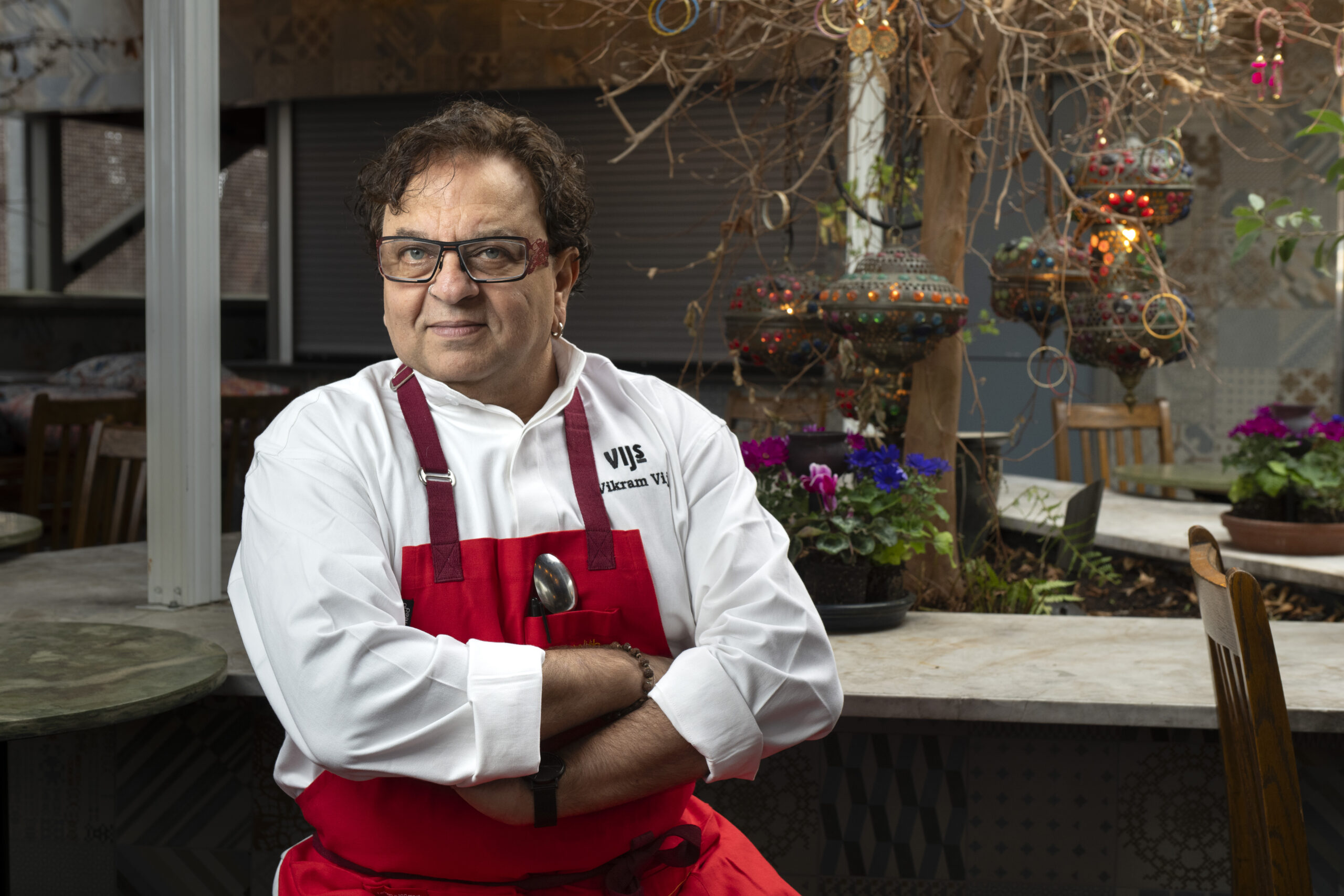
Chef Vikram Vij’s culinary journey began with studying hotel management in Austria, followed by honing his skills at some of Europe’s and Canada’s finest establishments, including the Hotel Post in Lech, the Banff Springs Hotel, and Bishop’s in Vancouver. In 1994, Chef Vij launched his first restaurant, quickly earning accolades such as Chef of the Year and recognition from the NY Times, with Mark Bittman praising it as “one of the finest Indian restaurants in the world.”
Chef Vij’s charisma and expertise have also led him to television, where he has appeared on numerous cooking shows and competitions, including Top Chef Canada, Chopped Canada, and Recipe to Riches. He made history as the first Indo-Canadian Dragon on the popular show Dragon’s Den and has delivered numerous keynote speeches, inspiring young chefs and championing local cuisine and winemakers.
In 2024, Vij’s had the distinct honour of serving the Duke and Duchess of Sussex, along with renowned Canadian singer Michael Bublé and his wife. Known for its innovative approach to Indian cuisine, Vij’s embodies the philosophy that while cuisines should evolve, they must also honour their deep-rooted heritage and culture.
Vij’s has garnered prestigious accolades, including the Bib Gourmand in 2023 and a Lifetime Achievement Award from the Vancouver Restaurant Awards, solidifying its status as a culinary landmark.
Looking back on your early years in Canada, which pivotal decision most influenced the trajectory of your restaurant career?
The most pivotal decision I made was choosing to present Indian cuisine as refined and elevated rather than categorizing it as inexpensive, casual fare. Indian food meant far too much to me culturally and emotionally to see it undervalued. I wanted the world to experience its depth, elegance, and complexity at the level of fine dining. That conviction ultimately led to the creation of Vij’s, and it fulfilled a promise I once made to my grandfather—that one day I would open a restaurant of my own. It was a deeply personal commitment that shaped both my vision and the standards I set for the restaurant.
Building a restaurant brand requires both culinary excellence and business discipline. Which side proved more demanding in your early years, and why?
The business discipline was far more demanding. I had strong culinary training, but operating a restaurant required mastering finance, systems, staffing, leases, margins, and growth strategy. The only way to truly learn was to immerse myself fully. Opening my first restaurant became my business education in real time. Every day presented new lessons about costs, customer expectations, team leadership, and the constant balancing act between creativity and profitability.
Canada’s dining landscape has evolved significantly over the past three decades. Which shifts have created the greatest opportunities for restaurateurs today?
Canada’s growing appreciation for global cuisines has created tremendous opportunities. Diners are more adventurous, more informed, and more interested in authenticity than ever before. There is also a stronger emphasis on local sourcing and sustainability, which allows chefs to tell deeper stories through their menus. Additionally, social media has given restaurateurs a direct platform to connect with guests and build loyal communities around their brands.
Many chefs struggle when transitioning from the kitchen to the boardroom. How did you develop the business acumen required to scale your ventures successfully?
It was a gradual evolution. Once my first restaurant gained popularity, revenue increased, but so did responsibility. I had to quickly understand cash flow management, reinvestment strategy, and long-term planning. I learned by surrounding myself with strong advisors, asking questions, and sometimes learning difficult lessons through experience. Growth forces discipline. Over time, I realized that strong operations, financial clarity, and the right people around you are essential to building a sustainable business.
Hospitality is ultimately a people business. What principles guide the culture you build within your restaurants and leadership teams?
Equality and respect are our core principles. Every person—whether a dishwasher, a server, or a guest—is treated with the same dignity. When your team feels valued, that energy naturally extends to guests. Culture is built on mutual respect and shared purpose. When people feel heard, supported, and proud of their work, they become deeply invested in the restaurant’s success and the experience we create together.
Consumer expectations around authenticity and innovation continue to rise. How do you balance staying true to culinary roots while keeping menus commercially relevant?
I stay rooted in traditional Indian techniques and flavours while embracing local Canadian ingredients and farmers. By sourcing locally, I honour both my heritage and the land where I cook. Trends will always evolve, but authenticity must remain constant. At Vij’s, we focus on the integrity of flavour and consistency of execution—that balance keeps us both relevant and genuine. At the same time, we remain open to subtle innovation, allowing creativity to enhance tradition without ever compromising its authenticity.
The economics of running restaurants in Canada have tightened in recent years. Where do you see the greatest operational pressures emerging for owners today?
Consumer spending has softened compared with previous years, and alcohol consumption has notably declined, significantly affecting margins. Rising labour and ingredient costs also put pressure. Restaurateurs today must operate with sharper efficiency while still delivering exceptional guest experiences, maintaining quality, and carefully managing every aspect of their operations.
Reflecting on your entrepreneurial journey, which failure or setback delivered the most valuable lesson?
Entrepreneurship always involves risk. I have taken risks that cost millions of dollars. However, I would rather take a risk and fail than live wondering what might have been. The lesson is not to avoid risk—but to take it thoughtfully and stand by your conviction. Each setback also teaches resilience, humility, and the importance of adapting quickly while staying committed to your long-term vision.
Brand loyalty in the restaurant sector can be fragile. What strategies have helped you build enduring trust with your guests?
Consistency. Every guest must receive the same level of care and quality, regardless of who they are. When people know they can trust the experience, loyalty follows. Over time, that reliability builds an emotional connection, turning first-time visitors into regular guests who confidently recommend the restaurant to others.
The Canadian market is increasingly competitive and diverse. What advice would you give to emerging immigrant entrepreneurs entering the hospitality space?
Find a mentor. Having someone experienced guide you through the realities of business is invaluable. Talent alone is not enough—you need perspective, accountability, and advice from someone who has walked the path before you. Mentorship also helps you navigate cultural differences, industry expectations, and the practical challenges of building credibility in a new market.
Beyond food quality, what operational details separate a good restaurant experience from a truly memorable one?
Memorable experiences are built on relationships. Guests often dine out to celebrate milestones or meaningful moments. When you understand why they are there and go beyond expectations to personalize the experience, it transforms a meal into a memory. Attention to small details—warm greetings, thoughtful service, and genuine hospitality—often leaves the deepest and most lasting impression.
Restaurant brands today often extend beyond dining rooms into packaged products, media, and collaborations. How do you evaluate opportunities that take the brand beyond the restaurant itself?
Any extension of the brand must reflect the same standards we maintain in the restaurant. Whether it is a packaged product, a collaboration, or a media opportunity, I ask whether it strengthens the reputation we have built with our guests. If the quality, story, and authenticity align with our philosophy, it can be a meaningful extension. If it risks diluting the brand, it is not worth pursuing.
Supply chains and ingredient sourcing have become more complex in recent years. How do you ensure consistency and quality while navigating these challenges?
Consistency begins with strong relationships. We work closely with trusted suppliers and local farmers who understand our standards and the importance of quality ingredients. Communication is key. When challenges arise, those partnerships allow us to adapt without compromising the integrity of the food. Maintaining those relationships over time creates stability in an industry where supply conditions can change quickly.
Leadership in hospitality often requires real-time decision-making under pressure. How do you personally stay focused and composed in high-stakes moments?
I have always approached challenges with calmness. Staying composed allows for clearer decision-making. In high-stakes environments, the team looks to leadership for stability. If you remain steady, they will too. Experience has also taught me to pause, assess the situation carefully, and act with clarity rather than reacting emotionally. That discipline helps maintain confidence and direction during the most demanding moments.
Expansion can be tempting for successful restaurateurs. What criteria must be present before you consider growing a concept or opening a new location?
Expansion must be financially sound and strategically aligned. I carefully review financial performance, cash reserves, market demand, and demographic fit. Growth should strengthen the brand—not stretch it beyond its capacity. Timing, operational readiness, and a strong management team are also essential before committing to any new location or concept.
Technology, delivery platforms, and changing dining habits are reshaping the industry. Which trends do you believe will have the most lasting impact over the next decade?
The rise of non-alcoholic beverages is one of the most significant long-term shifts. Consumers are becoming increasingly health-conscious, yet they still want sophisticated, thoughtfully crafted drinks that elevate the dining experience. Restaurants that innovate in this space, offering creative mocktails, botanical infusions, and premium alcohol-free options, will remain ahead of the curve while meeting the expectations of a new generation of diners.
Your season as a Dragon on Dragon’s Den introduced you to a new generation of entrepreneurs. What insights did that experience give you about the mindset of today’s founders?
Appearing on Dragon’s Den showed me that today’s founders are incredibly creative and visionary. Many have strong ideas but lack capital, structured marketing plans, or operational frameworks. The vision is often there—the execution strategy is what needs refinement. What impressed me most was their ambition and willingness to take risks early in their careers.
Sitting on the investor side of the table can shift one’s perspective. How did your time on Dragon’s Den influence the way you now evaluate opportunities and risk?
It sharpened my discipline. As an entrepreneur, you want to support bold ideas. But as an investor, you must balance optimism with financial responsibility. Not every promising idea becomes profitable. Risk is inevitable, but it must be measured. That experience reinforced the importance of clear fundamentals, realistic projections, and founders who understand the operational demands of scaling a business.
When you reflect on your legacy in Canada’s restaurant industry, what impact would you like your work to have had on the broader culinary landscape?
I hope I have helped position Indian cuisine as refined and worthy of recognition as fine dining in Canada. I also hope my work has strengthened relationships between restaurants and local farmers, reinforcing the importance of supporting Canadian agriculture. Ultimately, I would like to see the industry continue celebrating authenticity, quality ingredients, and the cultural stories behind every dish, ensuring that diverse culinary traditions are respected, elevated, and shared with future generations.
As you continue to lead and innovate, what still excites you most about the restaurant business today?
The limitless possibility. In hospitality, creativity has no ceiling. You can continually re-imagine experiences, flavours, and connections. The sky is truly the limit when your goal is to create something exceptional for your guests. Each new concept, menu, or collaboration offers an opportunity to surprise people and elevate the dining experience.
Jennifer M Williams | Editor-In-Chief